Encaustic cement tiles: a historical overview
Le carreau de ciment Cement tiles has undoubtedly been one of the most remarkable places in decoration since its appearance. Indeed, since its arrival in the 19th century, it has never ceased to be present. As specialists in cement tile mosaic carvings at Mosaics Torra, we would like to tell you more about its history and importance.
The art of mosaic through the ages
The art of mosaic began in Assyria, passed through ancient Greece and imperial Rome, and has reached the present day with the artistic conceptions and materials of each epoch.
History of cement tiles through the ages
The «grande ville» of Ninive
As mentioned in the Livre de Jonas, Ninive opened the first traces of what would later become the art of mosaic, with walls decorated with stone and clay mosaics.
From Greece to Rome the Roman historian Pline the Elder describes some of the most beautiful mosaics of the Hellenistic period. One of the most famous is the one preserved in the Maison du Faune at Pompei, representing Alexander the Great fighting the king of Perse, Darius III, made up of nearly a million and a half tesserae.
Mosaic decoration was so prevalent in imperial Rome that every single citizen ordered several mosaics to embellish his residence and his villa.
Mosaic arrives in Spain
Art arrived in Spain with the Romans and developed independently after the fall of the empire. Among the most famous examples are «Le Triomphe de Bacchus», discovered in Saragosse in 1908, and «Le Sacrifice d'Iphigénie», found in Gérone in the 19th century.
Modernisme
With the advent of modernism, cement tile carriages took on a new importance, to the point of becoming works of great artistic value, used by important designers such as Antonio Gaudí. This period saw geometric, floral and vegetal designs creating highly versatile compositions. Coloured cement tile carriages began to be designed, creating very attractive compositions.
From the 1920s to the 1950s
Cement tile trolleys were of considerable importance during the period from the 1920s to the 1950s. The carts of this period were characterised by neutral colours and designs with interlaced lines. In the 1950s, their decline began until they regained their present-day status. Their heyday was in the 1960s, when the use of cement tile carts was ubiquitous.
Cement tile trucks in the 1960s
Although cement tile carriages have existed for many years, they were one of the most widely used sun screens in houses in the 1960s. In fact, they became a major decorative trend until the 1970s, and many older homes still have carcasses from this period. The sizes of the carvings varied, but the most common were 20 x 20 cm, with geometric, geometric and floral motifs.
The typical way of laying cement tile carts in the 1960s was on a wall, covering the whole of the sun and using the carts to form a wall. In contrast to modern decoration with cement tile carts, their use on walls or work surfaces was not common. You can learn more about these designs in our articles on cement tile carousels.
Today's Cement tile Trolleys
Today, modern cement tile carriages can be combined in many ways, adapted to different styles of modernist decoration. For example, the decoration of worktops, bedheads or walls. There is no doubt that cement tile carriages remain a central element in many spaces.
Torra, a company based in Barcelona, maintains in Spain the millenary culture of mosaics and carvings. The traditional manufacturing methods, combined with a variety of artistic designs, make Torra the ideal choice to embellish your home or building with high quality and beautiful mosaics and cement tile carousels.
Consult Torra's technical department to plan your designs and give your residence, commercial centre or office an artistic touch of distinction.
Cement tile tile roads : Liés à Barcelone
To talk about cement tile roads and their history is to talk about Barcelona. It is one of the most characteristic features of the city. Indeed, they have contributed to making it one of the most original and authentic cities in the world. To speak of Barcelona is to speak of the cement tile masonry, thanks to a figure eternally associated with the city: Gaudí. Although the cement tile mosaic mosaic masonry was first seen in France, it quickly spread to other European countries, notably Barcelona and other Spanish cities.
Their initial appeal (and continued popularity) is due to several characteristics, in particular the fact that they are an inexpensive material that gives them a great deal of personality. In addition, they have several characteristics that have made them suitable for interior decoration as well as for the decoration of large public spaces.
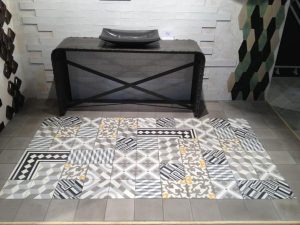
How Gaudí and others have made the cement tile mosaic carriage famous
The basic principles of cement tiles quickly demonstrated their immense potential. The first designs were decorative, with an abundance of geometric and floral mosaics, mainly destined for 19th century palace-houses in cities such as Vitoria, Séville and Barcelona. In Séville, they have become the main element of the emblematic monument of the Plaza de España.
The initial aim was to make the cement tile wheelbarrow into an artisanal piece resembling a coloured tapestry. Later, designers began to create their own designs, which has greatly contributed to its success. As an artisanal work, the cement tile mosaic carousel allows for entirely unique designs. This has encouraged designers to experiment with different combinations of colours, designs and textures.
Notable designers include Domènech, Puig and Calafach, but above all Gaudí, whose designs can still be seen on Passeig de Gràcia and at Casa Milà.
Gaudí's involvement in the history of cement tile tile work
Gaudí, the designer who made Barcelona famous, used all the potential of colours and costs to give a spectacular result to different spaces. It is impossible to talk about cement tile mosaic walls and their history without mentioning Gaudí.
The cement tile tile carriage is not only used to fill a space; it can also be used to delimit it and create different environments without the addition of walls or obstacles. With their infinite variety of designs and their low cost, cement tiles have become one of the most widely used materials since their appearance, surpassing other materials such as hardwood, glass or vinyl. Irrespective of the styles in fashion at any given time, cement tiles are suitable for everyone and have continued to offer their advantages for two centuries.
At Mosaics Torra, we invite you to discover our extensive catalogue, including designs inspired by the world of Gaudí and other styles such as the Victorian series, allowing you to make the most of every space. Decorate with personality, using the classic and fruitful tradition of cement tiles.
Histoire de la mosaïque dans la Rome antique : villas, palais et thermes
The history of mosaic in ancient Rome recounts its generalised use in villas, palaces and thermal baths. The art of mosaic is not of Roman origin; rudimentary techniques already existed in Sumer and were perfected by the Greeks. The word «mosaic» comes from the Greek «mousa» (museum). The occupation of Greece by Rome in the 2nd century B.C. led many masters to settle in the metropolis, expanding the technique. The expansion of the Roman Empire favoured its adoption throughout the territory under its rule.
In villas, mosaics served as a sign of social distinction. The more complex the construction and decorative motifs were, the higher the status of the owner, as the technique was complex and required resources and time. It was the same for imperial palaces or rulers' residences.
The thermae were the most characteristic public baths using cement tile decorations,
with a preference for maritime motifs and sea or water-related figures. However, the category of the piece or the wealth of the town also influenced their design.