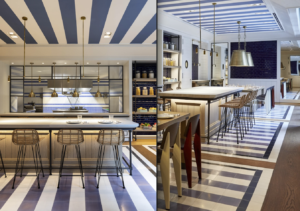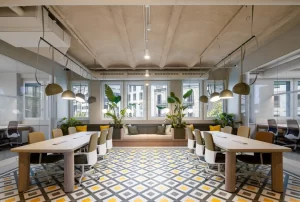
The encaustic cement tiles can undoubtedly occupy one of the most outstanding places in decoration since its appearance. In fact, since its arrival in the 19th century it has never ceased to be present. That is why, as craftsmen specialising in encaustic cement tiles, we at Mosaics Torra would like to tell you a little more about encaustic cement tiles and its history.
The art of mosaic began in Assyria, passed through ancient Greece and imperial Rome and has reached the present day with the artistic conceptions and materials of each period. History of encaustic cement tiles by periods The “great city” of Nineveh
Thus named in the Book of Jonas, in Nineveh
The first traces were found of what would later develop into the art of mosaic, a wall decorated with sections of stone and clay.
From Greece to Rome
The Roman historian Plini the Elder gives an account of some of the most beautiful mosaics of the Hellenistic period.
One of the most famous is the one preserved in the house of the Faun of Pompeia, which represents Alexander the Great fighting against the king of Persia, Darius III. It is made up of about one and a half million tessel-les.
Mosaic decoration was so common in imperial Rome that every wealthy citizen commissioned several mosaics to embellish his residence and his villa. The mosaic arrives in Spain
Art arrived in Spain
With the Romans and developed on its own after the fall of the empire.
Among the best known are El triomf de Bacus, discovered in Saragossa in 1908 and El sacrifici d'Ifigènia, found in Girona in the 19th century.
Modernisme
With the arrival of the Modernist period, the encaustic cement tiles began to acquire a new prominence, to the point that the encaustic cement tiles became an artistic piece of great value, used by important designers such as Antoni Gaudí.
During this period, geometric, floral and plant designs predominated, creating the most versatile compositions. They began to design coloured watercolour stripes, creating very colourful compositions.
From the 1920s to the 1950s
The cement tile began to take on an important role during the period from the 1920s to the 1950s. The style of cement tile used during this period was characterised by neutral colours with little colour, and designs with mainly interlaced lines. In the 1950s it began to decline, until it began to gain ground again in the present day.
However, it reached its peak in the 1960s, when the use of the hydraulic slab populated most of the estancias.
La rajola hidràulica als anys 60
Although the cement tile has been around for many more years since its origins, the truth is that in the 1960s it was one of the most widely used floor tiles in houses. In fact, it became one of the decorative trends of the time until well into the 1970s, and even today you can still find tiles from that period in old houses.
There were different sizes of cisterns, but the most common ones were 20 x 20. As for the most common shapes of the hydraulic slits of the period, they were made up of vegetal, geometric and even floral designs.
The most common way of laying the cement tile in the 1960s was as a catifa, covering the entire floor, and using slits that served to form a sanefa around it. Contrary to what happens with modern cement tile decoration, the use of this type of tile on parquet or tiled floors was not common. You can find more information about these designs in the article catifes amb rajoles hidràuliques.
Hydraulic mosaic in the present day
Nowadays, modern cement tiles allow a multitude of combinations, the times have changed and a variety of uses adapted to modernist styles of decoration are possible. An example of this is the decoration on tulles, hoods or parquet floors. There is no doubt that the cement tile continues to be the main feature of many rooms.
Torra is a Barcelona-based company that has given continuity in Spain to the millenary culture of mosaic and rajola.
The traditional manufacturing methods, together with the variety of artistic designs, make Torra the ideal choice to enhance your home or building with high quality and beautiful mosaics and cement tiles.
Consult Torra's technical department to plan your designs and give your home, commercial centre or office an artistic touch of distinction.
Hydraulic mosaic: arrelat a Barcelona
To talk about the encaustic cement tiles and its history is to talk about Barcelona. This is one of the most characteristic elements of the city. It is in fact a fundamental part of what has made it one of the most original and genuine cities in the world. Therefore, to speak of Barcelona is to speak of the encaustic cement tiles. This is due to one of the figures who will remain eternally associated with the City of Barcelona: Gaudí. Therefore, it must be said that, although encaustic cement tiless first made their appearance in France, they soon spread to other European territories.
As could not be otherwise, it ended up in Barcelona and other Spanish cities, which we will talk about later. Its initial boom (and the one that has always accompanied it) is due to various characteristics. However, we could say that the main ones have to do with the fact that it is an inexpensive material that gives a lot of personality. As well as having various characteristics that made it popular both in interior decoration and in the decoration of large public spaces.
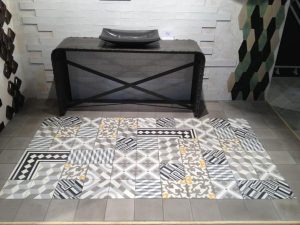
Hydraulic mosaic and its history How Gaudí and others made great the encaustic cement tiles
The beginnings of encaustic cement tiles soon showed the enormous possibilities it had. The first designs were based on a decorative intention with an abundance of geometric and floral mosaic designs. They were mainly intended for the 19th century mansions that were so common in some Spanish cities such as Vitòria, Seville and Barcelona itself. Moreover, in the case of Seville, it was the main feature of the emblematic monument in Plaça d'Espanya.
Naturally, they are also present in some French cities and rural towns. Thus, the initial intention was to make the encaustic cement tiles a handcrafted piece, the design of which gave the sensation of flowing like a colourful catifa.
It was not until later that some designers began to make their own designs. This point is important when referring to the encaustic cement tiles and its history, as it explains to a large extent why this piece was so successful. As we have said, encaustic cement tiles is a work of craftsmanship. This is because it gives us the possibility of making a totally unique design. Basically, encaustic cement tiles allows any design. This has encouraged designers to try out their own combinations of colours, designs and textures.
Among them, in addition to Domènech and Puig i Cadafalch, Gaudí's designs stand out. Specifically, Gaudí's designs can still be found on Passeig de Gràcia and in the Casa Milà. Gaudí's involvement in the history of encaustic cement tiless
Gaudí is the designer who made Barcelona great.
His unmistakable designs have contributed to giving the city this genuine character. In fact, it took advantage of all the potential in terms of colour and cost to give a spectacular result to the different spaces. We cannot talk about the encaustic cement tiles and its history without mentioning the figure of Gaudí.
Hydraulic mosaic is not only used to cover a space; it can also be used to limit it and create different environments without the need to add walls or obstacles. This is why, together with the infinite variety of different designs as well as its low cost, encaustic cement tiles has been one of the most popular materials since its appearance.
So much so that along the way it has left behind other materials that have gone out of fashion: noble shafts, glass, vinyl, etc. Whoever happens, regardless of the style that the fashion of each period may mark, the truth is that the encaustic cement tiles fits in with all of them and continues to provide its advantages for two centuries now.
That is why we at Mosaics Torra would like to invite you to get to know our extensive catalogue. As it could not be otherwise, first of all we wanted to include designs from the Gaudí universe. In addition, we have other types of designs such as those of the Victorian series that allow you to make the most of any space. Decorate with personality; with the secular and fruitful tradition of encaustic cement tiles.
The history of mosaic in Ancient Rome is the history of a discipline that became widespread in the villae, palaces and thermal centres.
In this article we refer to the most common cases and explain how this technique is applied today. History of the mosaic in Rome: villae, palaces and termes...
In order to determine the history of mosaic, it should be said that mosaic is not of Roman origin. Although rudimentary techniques already existed in Sumer, it was the Greeks who perfected it. In fact, the term mosaic comes from the Greek mousaes (muses). The occupation of Greece by Rome in the 2nd century BC meant that many of the masters moved to the metropolis and mastered the technique. Rome's status as an empire favoured its adoption throughout the territory under its rule. Mosaic tiling was a recurrent alternative, but it was also used for floors, walls and other motifs.
In the villae, mosaics were used as an element of social distinction. The more complex the construction and decorative motifs, the higher the status of the owner. We must not forget that this technique was complex and required the extraction of resources and time for the work. The same was true of imperial or governor's palaces.
Thermal baths were the most characteristic case of public buildings in which this decoration with encaustic cement tiless was used. Of course, priority was given to marine motifs and deities related to the sea or water. Nevertheless, it is certain that the category of the pond or the wealth of the city were influential factors.
Techniques used in Ancient Rome
The most common technique for creating mosaics was opus tessellatum. The primary material was tessellated tiles, cubes that are similar to rivers because they were of different colours. The condition was that they had to be more than 4 millimetres long. Subsequently, they had to be placed on a semi-liquid mass in order to fix them. In addition to the rivers, it was also possible to find remains of calcareous rock, or even marl or granite. In any case, as the years went by, the technique and the use of different types of tessel-les were perfected.
Another option was the opus vermiculatum, for more detailed cases. This was due to the fact that the tessellations were smaller and were usually carried from the workshop with the composition already made to fix them. When opus vermiculatum was used, priority was given to complex designs. Therefore, it should be noted that these designs tended to be more expensive if measured in square metres.
Both techniques were used for mosaic terracing; a base of opus tessellatum and, for the details, opus vermiculatum was applied. The most important factors were the cost of manufacture and, of course, the wishes of the owner. In any case, it is important to point out that, in Ancient Rome, this technique was expensive. Normally, only wealthy families or well-to-do municipalities had access to it. This can be applied both indoors and outdoors.