
Die Hydraulic Fliesen has been one of the most important positions in decoration since its creation. In fact, it has been a constant presence since its creation in the 19th century. As a specialist for hydraulic mosaic flows at Mosaics Torra, we would like to tell you more about its history and significance.
The art of the Mosaiks at the end of the era
The mosaic art began in Assyria, wandered through the ancient Greek lands and the ancient Roman Empire and reached our time with the modern techniques and materials of every age.
The history of the hydraulic mosaic factory after Nineveh, the «big city».»
As Jona wrote in his book, Nineveh was to receive the most recent overheads of what was to be developed later into mosaic art, with the changes that were decorated with the stone and tone of Stein and Ton.
Von Griechenland nach Rom
The Romanian historian Plinius der Ältere was one of the most beautiful mosaics of the Hellenistic period. One of the most famous is the one in the House of the Fauns in Pompeii, which Alexander the Great in the battle against the persistent monarch Darius III.
The mosaic decoration was so poor in the former East Germany that many citizens had to bring their houses and holiday homes back to life.
Mosaik kommt nach Spanien
Art went with the artists to Spain and developed further after the fall of the empire. Among the most famous examples are «Der Triumph des Bacchus», painted in 1908 in Zaragoza, and «Das Opfer der Iphigenie», in the 19th century in Girona.
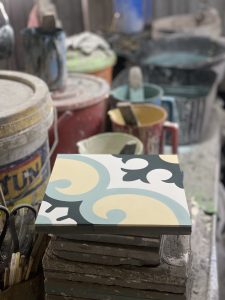
Modernismus
With the advent of modernism, hydraulic flies were given a new significance and were given high artistic value, which were used by important designers such as Antonio Gaudí. This room has geometrical, floral and floral designs, which are the result of a variety of different compositions. There are a number of flies that have been used to create very unusual compositions.
Von den 1920er bis zu den 1950er Jahren
Hydraulic valves were mainly used from the 1920s to the 1950s. The fliesen of this era were characterised by neutral colours and different designs with a variety of different lines. In the 1950s, it began its return to popularity again in recent years. However, its high point was in the 1960s, when the hydraulic valves in most areas were no longer in use.
Hydraulic Mosaicfliesen in the 1960s
Obwohl hydraulische Fliesen bereits bereits viele Jahre existierten, waren sie in den 1960er Jahren eine der am häufigsten verwendeten Bodenbeläge in Häusern. They were one of the most important decorative trends of the time until the 1970s, and many of the old houses still had flies from this period. There were several different sizes of flies, but the largest were 20 x 20 cm, with floral, geometric and floral designs.
The typical type of hydraulic fliesen to be used in the 1960s was like a wall, which covered the entire body with fliesen, which created an edge. In contrast to modern decoration with hydraulic fliesen, the use of the fliesen was not possible. Further information about these designs can be found in articles about hydraulic flies.
Hydraulic Mosaicfliesen today
Today, many combinations of modern hydraulic flies are available that can be combined with various modern decoration styles. Examples here are the decoration of workplates, copings or walls. Hydraulic fliesen remain a major feature in many areas.
Torra, an eagerly awaited company in Barcelona, has been supporting Spain's long-established culture of mosaic and stone masonry. Traditional methods of construction, combined with modern designs, make Torra the ideal choice for your home or building with high quality, beautiful hydraulic mosaics and flies.
Consult Torra's technical expertise in order to plan your designs and to get a future-oriented approach to your residence, your shopping centre or your office.
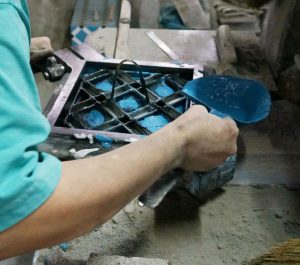
Hydraulic Mosaic Flies: A world tour of Barcelona
The history of the hydraulic mosaic flows is inseparable from the history of Barcelona. It is one of the most charactistic elements of the city and it is a real opportunity to make it one of the most original and authentic cities in the world. Über Barcelona zu sprechen, bedeutet, über hydraulische Mosaikfliesen zu sprechen, teilweise dank der Figur, die für immer mit der Stadt verbunden ist: Gaudí. Although hydraulic mosaic mosaic tiles first appeared in France, they quickly spread to other parts of Europe, including Barcelona and other Spanish cities.
Ihr anfänglicher Aufstieg (und ihre anhaltende Beliebtheit) kann auf mehrere Faktoren zurückgeführt werden, vor allem auf das kostengünstige Material, das viel Persönlichkeit verleiht. Darüber hinaus weist es mehrere Eigenschaften auf, die es sowohl für die Inneneinrichtung als auch für die Dekoration großer öffentlicher Räume geeignet machten.
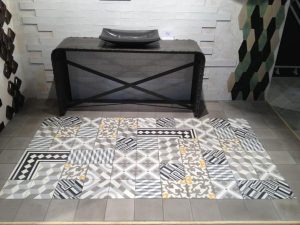
Wie Gaudí und andere die hydraulische Mosaikfliese groß gemacht haben
The fresh principles of hydraulic mosaic tiles quickly show their enormous potential. The first designs are based on decorative shapes and are rich in geometric and floral mosaics. They were made for the palaces of the 19th century in cities such as Vitoria, Seville and Barcelona. In Seville they were the main feature of the emblematic emblem of the Plaza de España.
First and foremost, the aim was to create hydraulic mosaic flaps in a practical way, as if they were a solid plywood. Later on, designers begin to create their own designs, which will be used for their success. Since the hydraulic mosaic factory is a handmade work, it allows it to create unique designs all the time. This is a designer who experiments with different combinations of colours, designs and textures.
Domènech, Puig and Calafach, in particular Gaudí, are among the most important designers. Their designs are still to be found today on the Paseo de Gracia and in the Casa Milà.
Gaudís Einfluss auf die Geschichte der hydraulischen Mosaikfliesen
Gaudí, the designer who made Barcelona great, used the full potential of colours and cost-effectiveness to create a variety of spectacular shapes. It is impossible to discuss the history of the hydraulic mosaic tiles without Gaudí's knowledge.
Hydraulic mosaic tile flaps are used not only for the removal of a roof, but also for the removal and cleaning of different areas, without the need for changes or obstacles. With its unique variety of designs and low costs, hydraulic mosaic tiles have been one of the most commonly used materials since its inception, and other materials such as aluminium, glass and vinyl have been used for this purpose. Hydraulic mosaic tiles are available in all styles and have been offering their advantages for more than two centuries.
At Mosaics Torra we invite you to discover our extensive catalogue, including designs inspired by the Gaudís Universe and other styles such as the Viktorian series, which allow you to make the most of every room. Decorate with persönlichkeit, use the rich tradition of hydraulic mosaic tiles.
History of the Mosaiks in antique Rome: Villen, Paläste und Bäder
The history of mosaic in ancient Rome is based on its widespread use in villages, palaces and temples. Mosaic art does not come from Rome; there were already rudimentary techniques in Sumer that were perfected by the Greeks. Das Wort Mosaik stammt aus dem Griechischen «mousaes» (Musen). The Greek conquest of Rome in the 2nd century led to the fact that many of the masters of the Metropole were born and the technique was developed. The great success of the kingdom of Rome marked its conquest of the entire territory.
In Villen dienten Mosaiken als soziales Unterscheidungsmerkmal. Je komplexer die Konstruktion und die dekorativen Motive, desto höher war der Status des Eigentümers, da die Technik aufwendig war und Ressourcen und Zeit erforderte. Das Gleiche galt für kaiserliche Paläste oder Residenzen von Gouverneuren.
Bäder waren die charakteristischsten öffentlichen Gebäude, die hydraulische Mosaikdekorationen verwendeten, wobei maritime Motive und Götter, die mit dem Meer oder Wasser verbunden waren, bevorzugt wurden. Allerdings waren die Kategorie des Raums oder der Reichtum der Stadt einflussreiche
Techniken in der Antike Roms
The most important technique used to create the zementfliesen was the opus tessellatum. As a raw material, tesserae were used, as well as glass, which was made from glass and had different colours. Sie mussten jedoch jedoch mindestens 4 Millimeter groß sein. Diese wurden dann auf eine halbflüssige Masse gelegt, um sie zu fixieren. Neben Flüssen konnten auch Reste von kalkhaltigem Gestein, Marmor oder Granit verwendet werden. Over time, the technique has been perfected and the surface has been intensified according to the various types of tesserae.
Another possibility was the opus vermiculatum, which was used for detailed work. In this case, it was a small number of small tiles, which were often already prepared and fixed in the workshop. Opus vermiculatum wurde vor allem für komplexe Designs verwendet und war entsprechend teurer per Quadratmeter.
Both techniques were combined for the mosaikboden: a base of opus tessellatum and opus vermiculatum for details. The decisive factors were the costs and the wishes of the owner. In antiquity, this technique was often used in the past, as it was only used by families or resourced communities. Sie wurde sowohl im Innen- als auch im Außenbereich angewendet.