For a kitchen worktop, terrazzo is the most artisanal and customisable material —colour and aggregate of your choosing— and, well sealed, hard-wearing and repairable. Against it, granite wins on hardness and heat, quartz on near-zero porosity and low upkeep, and marble on noble elegance, though it is the most delicate. Here's the honest comparison to choose well.
In our workshop we've worked cement and its aggregates since 1975, and we make bespoke worktops and tables in all of these materials. Precisely because we know them from the inside, this guide doesn't sell a single answer: every kitchen and every way of cooking calls for a different material. Let's take it step by step.
Why choose a terrazzo worktop? (and how it differs from granite, quartz and marble)
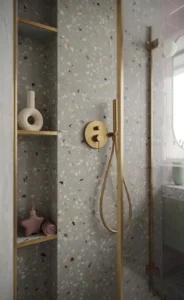
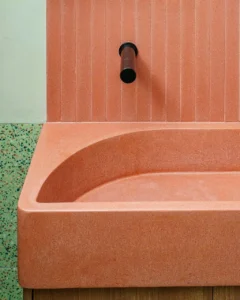
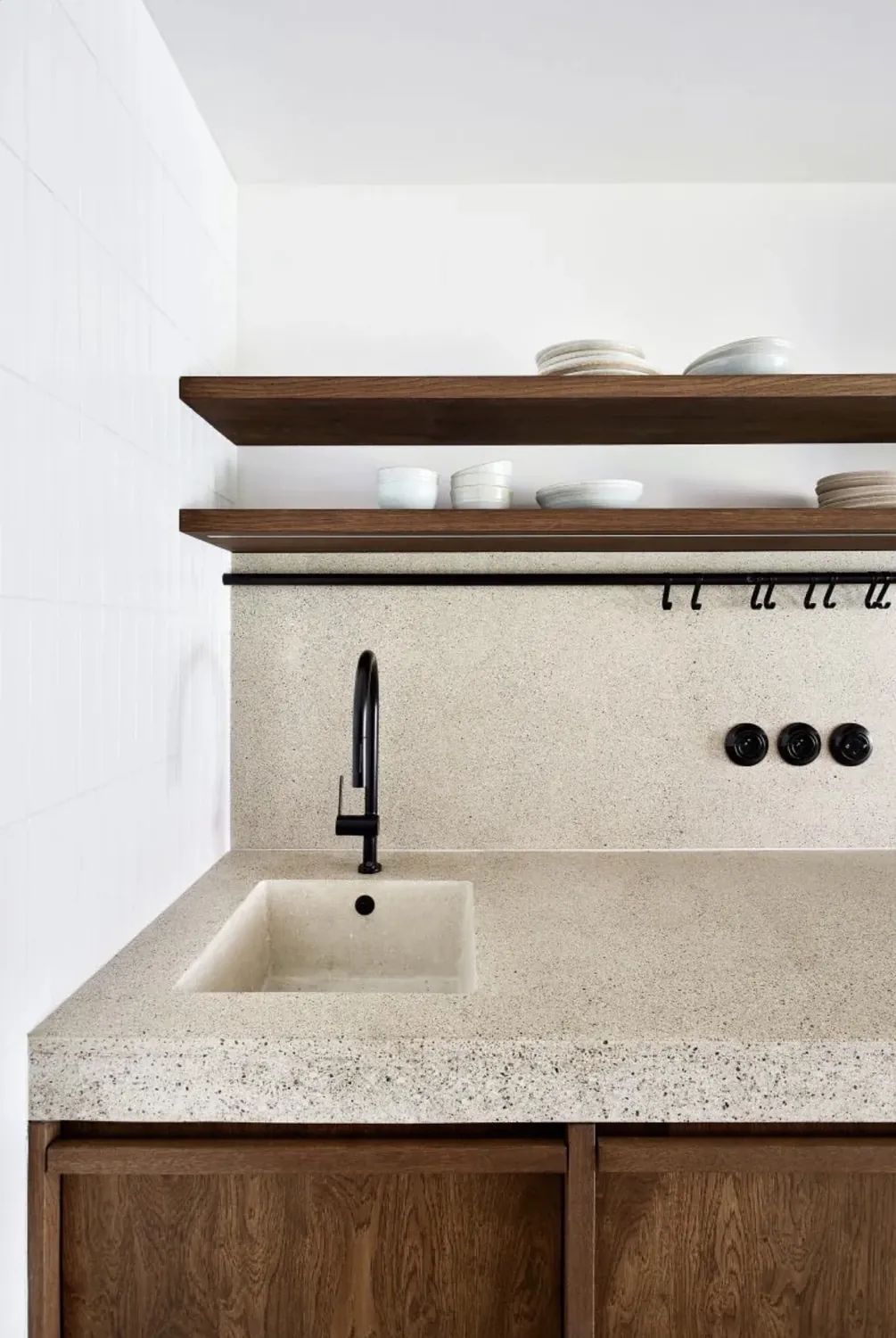
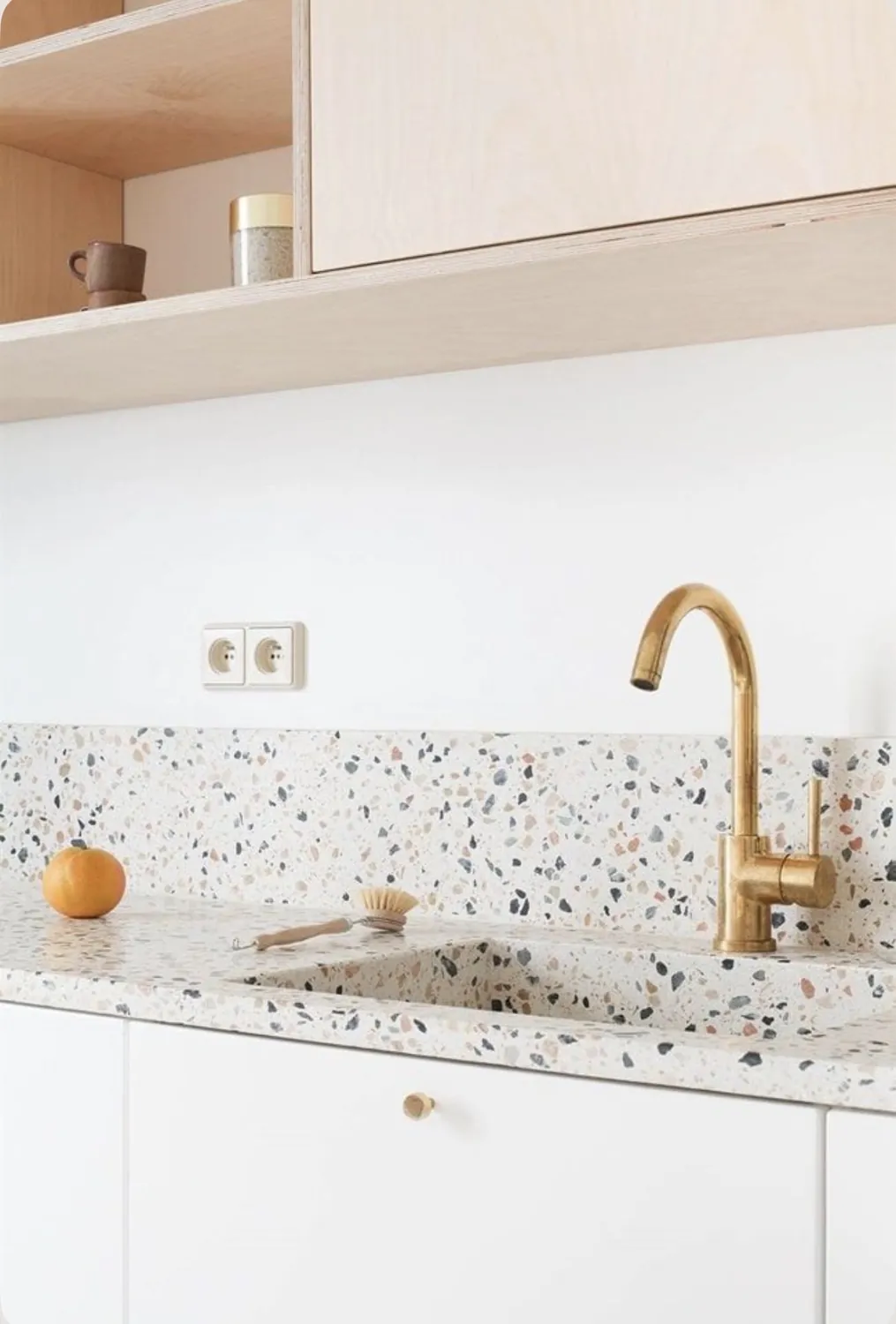
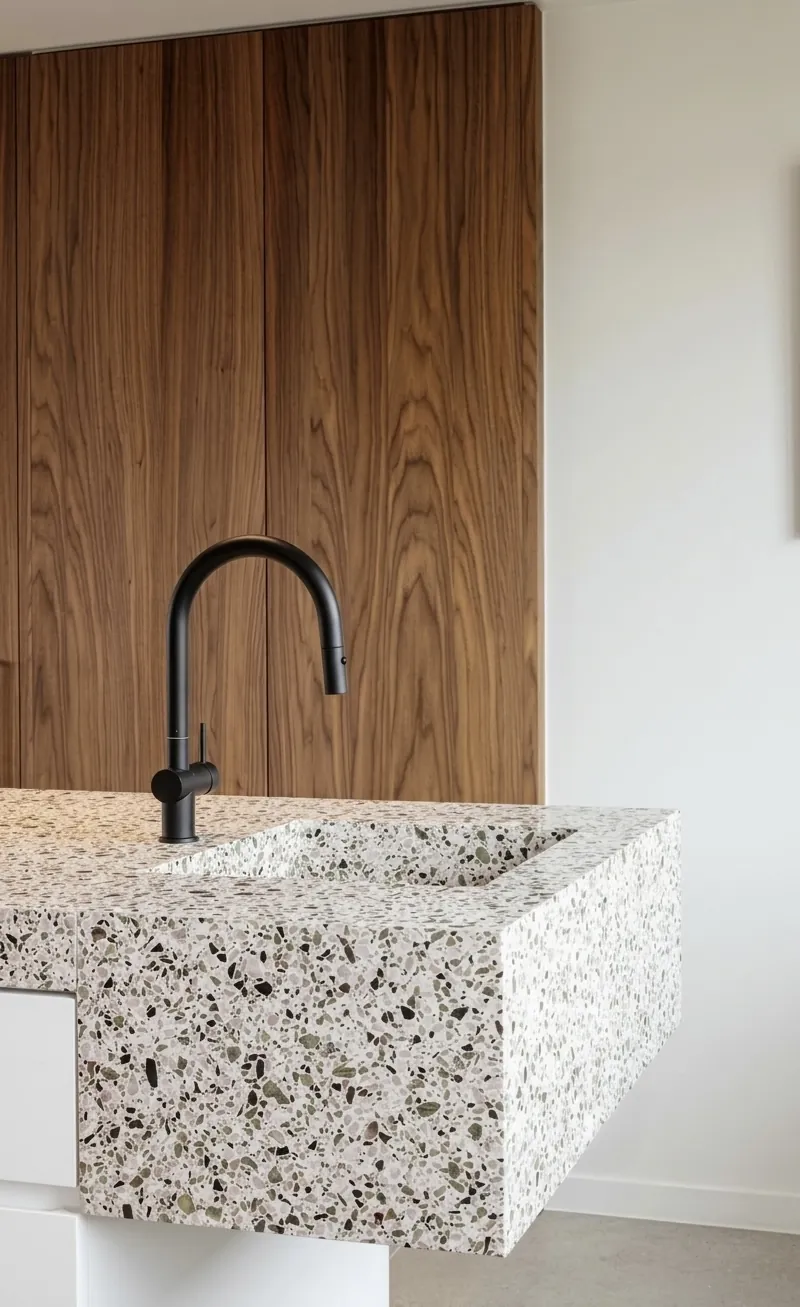
Terrazzo is a compound of aggregates —chips of marble, quartz or glass— bound in a cement base and polished to reveal the speckle. It isn't fired: it's cast, cured and polished. That nature is its great advantage for a kitchen, because it lets you choose the base colour and the aggregate mix, adjust the grain size and get a piece that exists in no fixed catalogue.
The other three materials start from very different places:
- Granite: natural stone of volcanic origin. Each slab is unique, and it's one of the hardest surfaces you can put in a kitchen.
- Quartz: an industrial agglomerate of quartz crystals bound with resins. Its finish is uniform and calibrated, without the veining surprises of natural stone.
- Marble: metamorphic natural stone with unique veining. It's the noblest, most elegant of the four, but also the softest and most porous.
Which material best withstands daily kitchen life?
This is where honesty matters, because the marketing of each material tends to hide its weak point.
Granite is the most heat-resistant: you can set down a pan straight off the hob without drama, and it's very hard to scratch. Quartz resists everyday scratching very well, but it has an Achilles' heel almost no one mentions: the resins binding it are sensitive to direct heat. A hot pan on quartz can leave a permanent yellowish mark, so there a trivet is not optional.
Marble is the softest of the four. It scratches and marks easily, and for a heavily used kitchen it is, let's be clear, the least forgiving. Terrazzo, by contrast, has a quality we value greatly in the workshop: it's repairable. Being a solid mass of cement and aggregate, a mark or surface wear is corrected by re-polishing and re-sealing the area —impossible on a resin agglomerate or a thin sheet. Over the years terrazzo doesn't 'spoil': it gains patina, and if ever needed, its shine is restored.
Which is more porous, and how much upkeep does each need?
Porosity decides how much you'll have to watch over the worktop. From least to most demanding:
- Quartz: the lowest porosity of the four. It barely absorbs, so it's the most 'forgiving' day to day.
- Granite: porous depending on the variety; it needs periodic sealing so it won't absorb grease or wine.
- Terrazzo: porous by nature, like any cement-based material. That's why we seal it in the workshop with a water-repellent treatment before delivering the piece, and that seal is refreshed from time to time with use. It's the step that makes it kitchen-ready without giving up its looks.
- Marble: the most delicate against stains and, above all, acids. A splash of lemon, vinegar or wine, if left, doesn't stain: it etches the surface, leaving a matte mark that cleaning won't remove. It requires sealing and immediate wiping of any spill.
How do you clean them daily?
For all four the rule is the same: mild soap and a cloth, nothing more. And on terrazzo, granite and marble you must always avoid acidic products and bleach; limescale removers and bathroom descalers, so aggressive, are exactly what etches natural stone and terrazzo. Marble is the least forgiving of a slip.
Which looks best for your kitchen style?
Beyond the technical side, each material tells a different story:
- Terrazzo: artisanal speckle with colour and aggregate of your choosing. It's the option with the most design freedom and the one that best suits kitchens with personality and interior projects looking for something the neighbour doesn't have.
- Granite: natural veining and deep tones, right at home in classic kitchens with character.
- Quartz: smooth and uniform, the safe choice for minimalist kitchens after visual continuity.
- Marble: the noblest, most elegant veining, a one-off piece. The favourite of high-end kitchens where looks come before resistance.
What about onyx, microcement or reconstituted granite?
There's more to the family. Onyx is the most exclusive: a translucent, spectacular and very delicate stone, usually reserved for a detail or a backlit panel rather than the whole working worktop. Microcement, for its part, offers seamless continuity when you want that monolithic effect. In the workshop we work these to measure too; if your project leans that way, we can look together at which materials suit your kitchen worktop best.
So, which kitchen worktop should I choose?
If we had to sum it up in four lines:
- You want an artisanal piece, customisable in colour and aggregate, with character and repairable → terrazzo.
- You cook a lot and want to forget about upkeep → quartz.
- You want unique natural stone and the best heat resistance → granite.
- You prioritise the noblest looks and accept caring for it → marble.
At Mosaics Torra we make bespoke terrazzo worktops —and in granite, quartz, marble and microcement too— with technical guidance from start to finish. We're not a slab retailer: we're a workshop that cuts, casts, polishes and seals every piece. The best way to decide is to hold the material in your hand.
Ask for a terrazzo sample and compare it in your kitchen's light before deciding. And if you want to go beyond the kitchen, see all our bespoke pieces or the bespoke bar counters for hospitality projects.
Frequently asked questions
Is terrazzo a good option for a kitchen worktop?
Yes. Sealed with a water-repellent treatment in the workshop, terrazzo is hard-wearing, fit for a work surface and, unlike other materials, repairable: a mark is corrected by re-polishing. It's also the most customisable in colour and aggregate.
What's better for a worktop: terrazzo, granite or quartz?
It depends on your priority: for design and personalisation, terrazzo; for maximum hardness and heat resistance, granite; for the lowest possible upkeep, quartz. There's no single winner —there's a winner for each kitchen.
Is marble suitable for a kitchen worktop?
It can, but it's the most delicate: it scratches easily and acids (lemon, vinegar, wine) etch its surface. It needs sealing and daily care. It's ideal if you prioritise noble looks over resistance.
Which worktop needs the least upkeep?
Quartz, thanks to its near-zero porosity. At the opposite end, marble demands the most attention.
Can you make a bespoke terrazzo kitchen worktop?
Yes. We make bespoke worktops and tables to the exact dimensions of your kitchen, choosing the base colour and aggregate mix, and we seal every piece in the workshop before delivering it.